

An indoor cat that eats treats quickly may benefit from a toy that turns snack time into a paw-and-nose activity, but the wrong design can create a different problem: a puzzle that takes too much floor space, is difficult to clean, or frustrates your cat may sit unused. The PETSTA option in this guide combines treat dispensing with sliding and hiding activities, so the main decision is whether its size, challenge level, and care requirements fit your cat’s routine.
This guide to Best Treat Dispensing Cat Puzzle Toys helps you assess the toy’s dimensions, play styles, construction, stability, cleanup, and supervision needs. For more ideas in this category, you can also browse the site’s puzzle toy collection before deciding how much variety your cat’s play area needs.
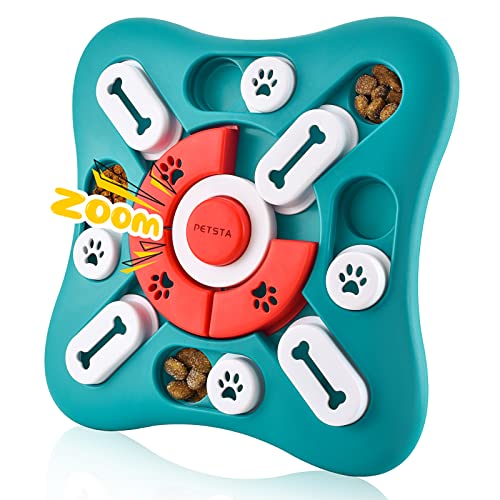
Play style and challenge level
A puzzle toy is useful only when your cat can understand the basic task and remains interested in the reward. The PETSTA listing describes three ways to play, including spin-and-slide and seek-and-hide activities, with a squeak button in the center intended to attract dogs and cats. Its 16-hole treat dispenser is also described as a slow-feeding design.
Those features give you more than one activity to try, but they do not establish that every cat will find the toy easy or engaging. A food-motivated cat that already paws at sliding objects may have a natural starting point, while a cautious cat may need a simpler introduction with treats placed where they are easy to find. Begin with the least frustrating setup, and verify that your cat can access the reward without chewing the toy.
Dimensions and available floor space
The listed dimensions are 10 inches by 10 inches by 1.3 inches. That gives you a concrete footprint to plan around, especially if the toy will be used in a narrow kitchen, apartment, or room already filled with feeding and resting equipment.
A broad, flat design can provide room for several play areas, but it still needs a clear surface so your cat can reach the sliders from different angles. Measure the intended location before ordering, then consider whether the toy can be stored upright or in a cabinet when not in use. The supplied information does not specify storage features, so storage convenience should be treated as something to verify rather than assume.
Stability during pawing and sliding
Movement can make a puzzle harder to use, particularly when a cat is trying to move a slider while reaching for a treat. The listing states that four anti-skid pads are fitted to the bottom, with the purpose of helping the toy stay in place during use.
That feature is relevant for cats that use their paws deliberately, but it does not guarantee that the toy will remain fixed on every floor or during vigorous play. Place it on a level, clean surface and observe the first sessions. If your cat pushes, flips, or bites puzzle toys, stability and supervision deserve more attention than the advertised number of play modes.
Cleaning access and treat residue
Treat crumbs and saliva can collect around holes, tracks, and moving sections, so cleanup matters when the toy is used often. The product listing says the toy is easy to clean and dishwasher safe, but it does not clarify whether every part or the entire assembled product should go in a dishwasher.
That distinction is important. Before relying on dishwasher cleaning, check the current manufacturer instructions for the correct method and temperature. You should also inspect the tracks and treat openings after each use for residue, especially when using moist treats. Households that prefer quick wipe-downs should confirm that the recessed play areas are accessible enough for their routine.
Construction and supervision
The listing describes built-in play parts that are not removable and says they fold tightly into the design. It also identifies the material as non-toxic, a manufacturer claim that should not be treated as an independent certification or a guarantee against wear.
Non-removable components may reduce the chance of a loose slider being separated from the toy, while also making deep cleaning or replacement of an individual part less straightforward. The listing specifically advises caution with aggressive chewers. Although that warning is aimed at dogs, it is sensible to supervise any cat that bites, scratches, or attempts to pry pieces loose. Remove the toy if you see cracking, sharp edges, or damaged sections.
Treat routine and household expectations
This is a treat-dispensing enrichment toy, not a complete feeding system. The listing says the design can extend slow-feeding time beyond 20 minutes, but that is a manufacturer statement and should not be treated as a guaranteed duration for every cat. Your cat’s treat size, persistence, and familiarity with the puzzle will affect the experience.
Use treats that fit securely in the openings and account for them within your cat’s normal daily intake. If you need a toy for scheduled meals, medication delivery, or unsupervised access, verify that use case separately because the supplied information does not establish those capabilities. For broader pet-play ideas, the site’s play category may help you compare this type of enrichment with other activities.
How We Compared These Products
This guide compares the single listed PETSTA model using the supplied dimensions, described play modes, treat-hole design, anti-skid pads, built-in components, cleaning claims, and stated caution for aggressive chewers. No firsthand product evaluation is documented, so the recommendations are based on the published product information rather than observed performance. Features such as the 20-minute slow-feeding claim are presented as listing claims, not guaranteed outcomes.
Which Option Fits Your Pet and Home?
For cats that enjoy paw-based problem solving: PETSTA Dog Puzzle Toys, Treat Dispensing Dog is the more relevant choice when you want several listed activities in one toy. Its spin-and-slide and seek-and-hide designs give you different ways to present treats, although you should start with the easiest activity and supervise until you know how your cat interacts with it.
For a home where floor space and movement matter: The same PETSTA Dog Puzzle Toys, Treat Dispensing Dog has a listed 10-by-10-inch footprint and four anti-skid pads. Measure your available surface first, and do not assume the pads will prevent movement on every floor or with every play style.
For owners who prioritize cleanup: PETSTA Dog Puzzle Toys, Treat Dispensing Dog may fit if the manufacturer’s cleaning instructions match your routine, because the listing describes the toy as easy to clean and dishwasher safe. Confirm whether that applies to the full toy or only particular sections. Pros: multiple play designs, a flat format, built-in play components, and listed anti-skid pads. Cons: the information does not establish suitability for every cat, dishwasher treatment for every part, or unsupervised use. Who should skip it: households seeking a scheduled feeder, a toy specifically rated for unsupervised play, or a design for an aggressive chewer should look for a product with those limitations clearly documented.
Frequently Asked Questions
Can cats use this puzzle toy?
The listing identifies the toy for dogs and cats and describes paw-based sliding and hiding activities. Individual cats vary, so introduce it with easily accessible treats and supervise the first sessions.
How large is the PETSTA puzzle toy?
The supplied dimensions are 10 inches by 10 inches by 1.3 inches. Allow additional clear space around it so your cat can approach and manipulate the play areas.
Does it dispense treats slowly?
The listing describes a 16-hole treat dispenser and claims that slow-feeding play can extend beyond 20 minutes. Actual timing will depend on the treat and the cat, so treat this as a product claim rather than a guaranteed result.
Is the entire toy dishwasher safe?
The listing says the toy is dishwasher safe, but the supplied information does not specify whether that applies to the complete assembled toy or particular portions. Check the current care instructions before placing it in a dishwasher.
Does it have removable pieces?
The product description says it has no removable parts and that the built-in play parts fold tightly into the design. Inspect the toy regularly for damage, since fixed components do not eliminate the need for supervision.
Can a cat use it without supervision?
The supplied information does not establish that it is suitable for unsupervised play. Supervise cats that chew, scratch, or try to pry at the toy, and remove it if any portion becomes damaged.
Bottom Line
The PETSTA model is most plausible for a cat that enjoys treat-based paw play and a household with enough surface space for its 10-by-10-inch footprint. Its multiple listed activities, anti-skid pads, and stated cleaning claim are useful starting points, but you should verify care instructions, choose suitable treats, and supervise play instead of assuming that every cat or routine will be a match.





Write Your Review
No reviews yet. Be the first to share your experience!