

If your workday runs late or two cats compete for the same bowl, an automatic feeder can make scheduled dry-food meals easier to manage. The wrong design can still create problems: a hopper may need frequent refills, an outlet may not suit your kibble, or a shared feeding station may not give each cat enough space.
This guide to Best Automatic Cat Feeders for Dry Food compares options by schedule and portion controls, capacity, multi-cat layout, food handling, cleaning, and backup power. Use those details to narrow the choice, then confirm that the model suits your pet’s food and feeding plan.

Pros
- Separated bowls for two cats
- Up to six scheduled meals daily
- Supports 2 to 18 mm dry food
- Removable parts for cleaning
- Backup battery power
Cons
- Four AA batteries are not included
- Who should skip it: Owners needing wet-food dispensing
Pros
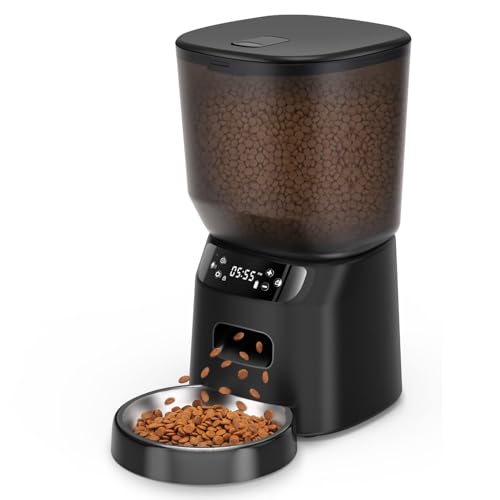
- Programs up to six meals per day
- Timed portion control
- Stainless steel bowl listed
Cons
- Food capacity is not specified
- Power details are not specified
- Who should skip it: owners needing confirmed capacity or power specifications

Pros
- Up to 10 scheduled meals per day
- Adjustable portions and app-based scheduling
- Feeding records and issue notifications
- Stainless steel food bowl
Cons
- Who should skip it: owners seeking a non-automatic feeder

Pros
- Programmable daily meal schedule
- Two power options
- Removable food tray
- Manual portion dispensing
Cons
- D-cell backup batteries are not included
- Who should skip it: owners needing wet-food or app-based feeding

Pros
- Up to eight scheduled meals daily
- Supports two pets
- Recorded voice reminders
- Battery backup option
- Stainless steel feeding tray
Cons
- Backup batteries are not included
- Designed for dry food only
- Who should skip it: Wet-food households

Pros
- Flexible one-to-six meal scheduling
- Adjustable portions up to 20 servings
- Power-outage battery backup option
- Desiccant pack included
- Removable food tank
Cons
- Only suitable for dry food under 0.4 inches
- Three D batteries are not included
- Base should not be cleaned

Pros
- Up to six meals per day
- Adjustable portions for cats and small dogs
- Backup battery power
- Airtight storage features
- Personalized voice meal call
Cons
- No camera or app connectivity
- Who should skip it: users wanting app or camera connectivity

Pros
- Large dry-food capacity
- Flexible meal scheduling
- Adjustable portion control
- Slow-feed option
- Dual power sources
Cons
- Three D-cell batteries are not included
- Designed for dry food
- Who should skip it: Wet-food users

Pros
- 3L dry-food capacity
- Schedules 1 to 6 daily meals
- Programmable portions
- Dual power supply
Cons
- Portion amounts are not specified
- Backup power type is not specified
- Who should skip it: owners who need exact portion or backup-power details

Pros
- Designed for feeding two cats separately
- Large 5-liter dry-food capacity
- Up to six meals per day
- Dishwasher-safe stainless steel bowls
- Simple dial-based setup
Cons
- Only accommodates kibble smaller than 0.5 inch
- Who should skip it: households needing wet-food dispensing
- Power source and backup battery are unspecified
How to Choose Best Automatic Cat Feeders for Dry Food
Match the schedule and portions to your cat’s routine
Meal limits and portion units vary, so compare them with your veterinarian-approved daily food amount rather than assuming a “portion” is the same across models. The PETLIBRO Automatic Cat Feeder, B09S8WMJY9, lists up to 10 meals daily and portions of 1/12 cup each. The PETLIBRO Automatic Cat Feeder, B0953SDCRG, lists up to six meals, with each portion described as 2.5 teaspoons. These are different models with different portion definitions.
Other options list up to six meals, including the IMIPAW PET Automatic Cat Feeder and Faroro Automatic Cat Feeder. Faroro also lists a slow-feed mode. Check the manual and portion calibration before relying on a feeder for precise weight management, since dry-food shapes and sizes can affect how much a dispensing unit delivers.
Choose capacity for your actual refill routine
Capacity can reduce how often you refill, but a larger hopper is not automatically a better fit. The listed choices range from 3L models, such as the IMIPAW feeders, to the 5L PETLIBRO and oneisall models, a 6L ANDOLL HOME model, and an 8L two-pet Nityers model. Food consumption differs by pet and diet, so do not treat advertised days of feeding as a guarantee.
For a compact routine or a single cat with moderate consumption, a 3L hopper may be sufficient if you are comfortable refilling it as needed. For multiple pets or fewer refill trips, compare the larger capacities, while keeping the feeder’s footprint and food freshness in mind. Place it where you can reach the lid and remove the bowl without moving other household items.
Check kibble compatibility and jam information
Feeders rely on a dispensing outlet, and not every listing provides a supported kibble range. The Nityers Automatic Cat Feeder for 2 Cats specifies dry food from 2 to 18 mm. The oneisall Automatic Cat Feeder for 2 Cats Pets lists kibble under 0.5 inch, while the IMIPAW PET Automatic Cat Feeder lists food under 0.4 inch.
Measure or check your food packaging against the model’s stated limits, especially for unusually large or irregular kibble. Several listings describe anti-clog features, but those claims do not guarantee jam-free operation with every food. If a feeder does not specify kibble size, ask the manufacturer before purchasing.
Consider bowl arrangement in multi-cat homes
Two-bowl feeders may help when cats can eat at the same time but need separation. The Nityers model places bowls on opposite sides with about 21 inches between them, and the oneisall model describes opposite bowls 16 inches apart. The ANDOLL HOME listing identifies use for two pets, but does not specify bowl spacing.
Measure the available floor area and consider whether both cats will comfortably approach the station. A shared hopper also means the cats receive food from one programmed system; it is not a substitute for individually controlled diets or separate portions if one pet must eat a different amount.
Plan for power interruptions and controls
Many listed feeders support an adapter plus batteries, but the battery type and whether batteries are included differ. For example, the PETLIBRO B0953SDCRG uses USB-C and three D-cell batteries, while the IMIPAW PET model lists three D-size alkaline batteries as backup. The Nityers model lists four AA batteries. Check the exact listing and keep compatible backup batteries available if uninterrupted scheduling matters.
App control is a distinct convenience, not a universal feature. The PETLIBRO B09S8WMJY9 lists app scheduling over 2.4GHz and 5GHz Wi-Fi, while other models describe onboard programming. Choose remote controls only if you want to manage schedules through a phone and your home network meets the stated requirements.
Check what comes apart for cleaning
Food residue and crumbs make access to removable parts important. The Nityers listing says the hopper, lid, rotor, bowl, and tray are removable. The oneisall listing specifies stainless steel bowls and says those bowls are dishwasher-safe; that does not mean the feeder base or hopper can go in a dishwasher. The IMIPAW PET model says its food tank can be disassembled and cleaned, and warns not to clean the base.
Look for care instructions for each component before washing. Desiccant bags and sealing features may help limit moisture exposure according to listings, but they do not eliminate the need to refresh food and clean the parts as directed.
How We Compared These Products
This guide is based on product research, using supplied listing specifications and design descriptions, including meal scheduling, portion units, hopper capacity, bowl layout, kibble limits, cleaning access, and power options. No firsthand evaluation is documented, and the supplied product data does not include usable customer feedback. Manufacturer-described features are presented as listing claims, not independently verified performance.
For broader feeding options, browse our pet feeding supplies. If removable bowls and hoppers are a priority, our cleaning category may also help you consider related upkeep products.
Which Option Fits Your Pet and Home?
For two cats that need more space at meals: The Automatic Cat Feeder for 2 Cats lists opposing bowls about 21 inches apart, an 8L hopper, and a stated kibble range of 2 to 18 mm. Its larger capacity and footprint may not suit a tight feeding corner, so measure before choosing.
For app-based scheduling: The PETLIBRO Automatic Cat Feeder lists Wi-Fi app programming, up to 10 meals daily, feeding records, and alerts for conditions such as low food or a jam. It requires compatible Wi-Fi, so it is less suitable if you prefer a simple onboard-only setup.
For a lower-capacity feeder with several scheduled meals: The IMIPAW PET Automatic Cat Feeder lists a 3L tank, up to six meals, and up to 20 portions per meal. Its listed kibble limit is under 0.4 inch; choose another model or confirm compatibility if your food is larger.
Skip a feeder if your pet needs direct supervision while eating, has a feeding plan that requires individual access, or eats wet food. These listed products are presented as dry-food dispensers, and automation does not replace checking that the pet has eaten and that the mechanism is working.
Frequently Asked Questions
Can these feeders dispense any dry cat food?
No universal compatibility is established. Check the selected model’s stated kibble-size limit, and verify with the manufacturer if the listing does not provide one or your food is unusually shaped.
How much food does one portion dispense?
Portion definitions vary by model. For example, oneisall lists about 10 grams per portion, PETLIBRO B09S8WMJY9 lists 1/12 cup, and PETLIBRO B0953SDCRG lists 2.5 teaspoons. Confirm the model’s instructions and measure output before setting a daily ration.
Can one feeder serve two cats?
Some listed models have two bowls, including the Nityers and oneisall feeders. Shared feeding is not appropriate if cats need different food or individually controlled portions, and bowl spacing should be checked against your room and pets.
Can I wash the entire feeder in a dishwasher?
Do not assume so. The oneisall listing describes its stainless steel bowl as dishwasher-safe, while other parts and models have separate cleaning instructions. Check the manual for each removable component and keep the powered base dry.
Do these feeders keep working during a power outage?
Several models list battery backup alongside an adapter, but battery types vary and batteries may not be included. Confirm the exact power requirements and test the backup setup according to the manufacturer’s directions before relying on it.
Is a voice recording or phone app necessary?
No. A voice message can provide a familiar mealtime cue on models that include it, and app control can enable remote scheduling on compatible models. If you only need a fixed schedule, an onboard programmable feeder may be enough.






Write Your Review
No reviews yet. Be the first to share your experience!